✝
Patron Saint of the Trades
SAINT ELIGIUS
Goldsmith, counselor to kings, bishop, and liberator of slaves — the man who forged beauty with his hands and gave everything away with his heart.
588 AD — 660 AD · Feast Day: December 1
Patron Saint of the Trades
Goldsmith, counselor to kings, bishop, and liberator of slaves — the man who forged beauty with his hands and gave everything away with his heart.
588 AD — 660 AD · Feast Day: December 1
The Man Before the Saint
Eligius was born into a Gallo-Roman family near Limoges in modern-day France around 588 AD. His father, Eucherius, recognized an uncommon talent in the boy early on and apprenticed him to a master goldsmith named Abbo, who ran the royal mint at Limoges.
Eligius took to metalwork immediately and excelled through his apprenticeship. His skill eventually drew the attention of the Frankish royal court, setting in motion a life that would move from the forge to the throne room to the bishop's seat — and finally into sainthood.
Before he was a bishop, before he was a saint — he was a man who worked with his hands.
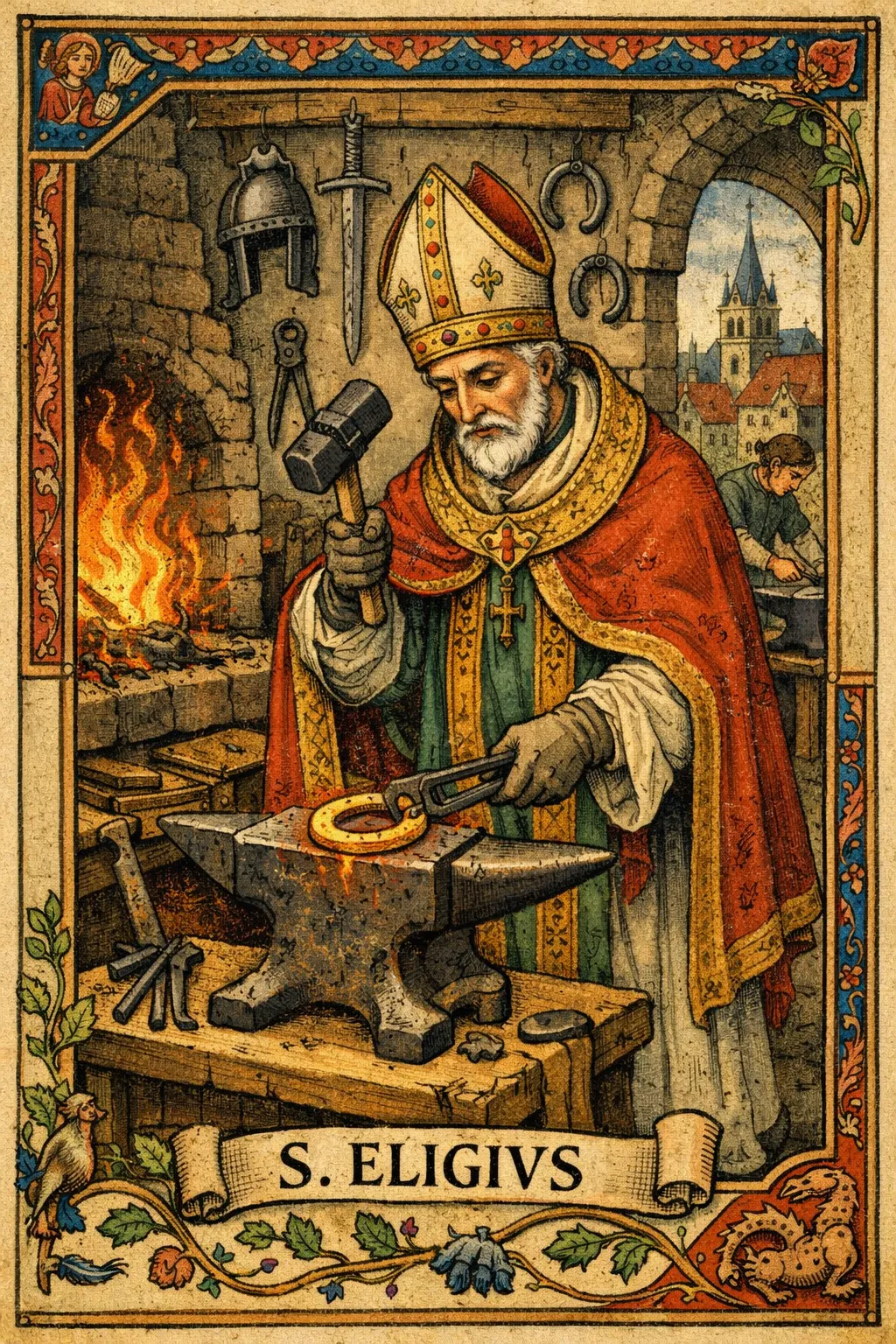
“ The king gave Eligius gold and precious stones to build one throne. Eligius — so skilled and so honest — built two. He returned the surplus rather than pocket it. The king was so astonished he made Eligius master of the royal mint.
The Story of the Two Thrones — Vita Sancti Eligii
A Life in Full
Born into a Gallo-Roman family about six miles north of Limoges in what is now France. His father noticed his son's unusual talent for working with metal and enrolled him as an apprentice to a goldsmith.
After training under Abbo at Limoges, Eligius traveled to the Frankish court where he worked under the royal treasurer Babo. His extraordinary craftsmanship caught the eye of King Clotaire II, who commissioned him to build a golden throne — and received two instead of one.
Impressed by both his skill and integrity, King Clotaire appointed Eligius as master of the mint. Coins minted under his authority still survive today. His reputation for honesty became legendary in an era where fraud in metalwork was routine.
After Clotaire's death, his son Dagobert I kept Eligius in the royal household and eventually made him chief counselor. Ambassadors and nobles would seek Eligius's advice before even reaching the king. He used this influence to champion the poor and ransom captive slaves.
Using his personal wealth, Eligius purchased a villa near Limoges and established the monastery of Solignac. He also founded a large convent in Paris. Both followed the strict Irish monastic rule introduced to the continent by St. Columbanus.
After years of growing devotion, Eligius fulfilled his desire to serve God directly and was ordained. He stepped away from the royal court and turned fully toward the Church, driven by a deepening spiritual calling that had been building throughout his years of wealth and influence.
When the Bishop of Noyon-Tournai died, Eligius was chosen as his successor with overwhelming support from both clergy and laity. Most of his new diocese was still pagan. Eligius threw himself into missionary work across Flanders, converting communities throughout what is now Belgium and the Netherlands.
Eligius died at Noyon around age 71. He was buried in the city where he had served as bishop for nearly two decades. His remains became objects of deep veneration throughout the Middle Ages, and his feast day — December 1 — is still celebrated across Europe, particularly in France and Belgium.
Character
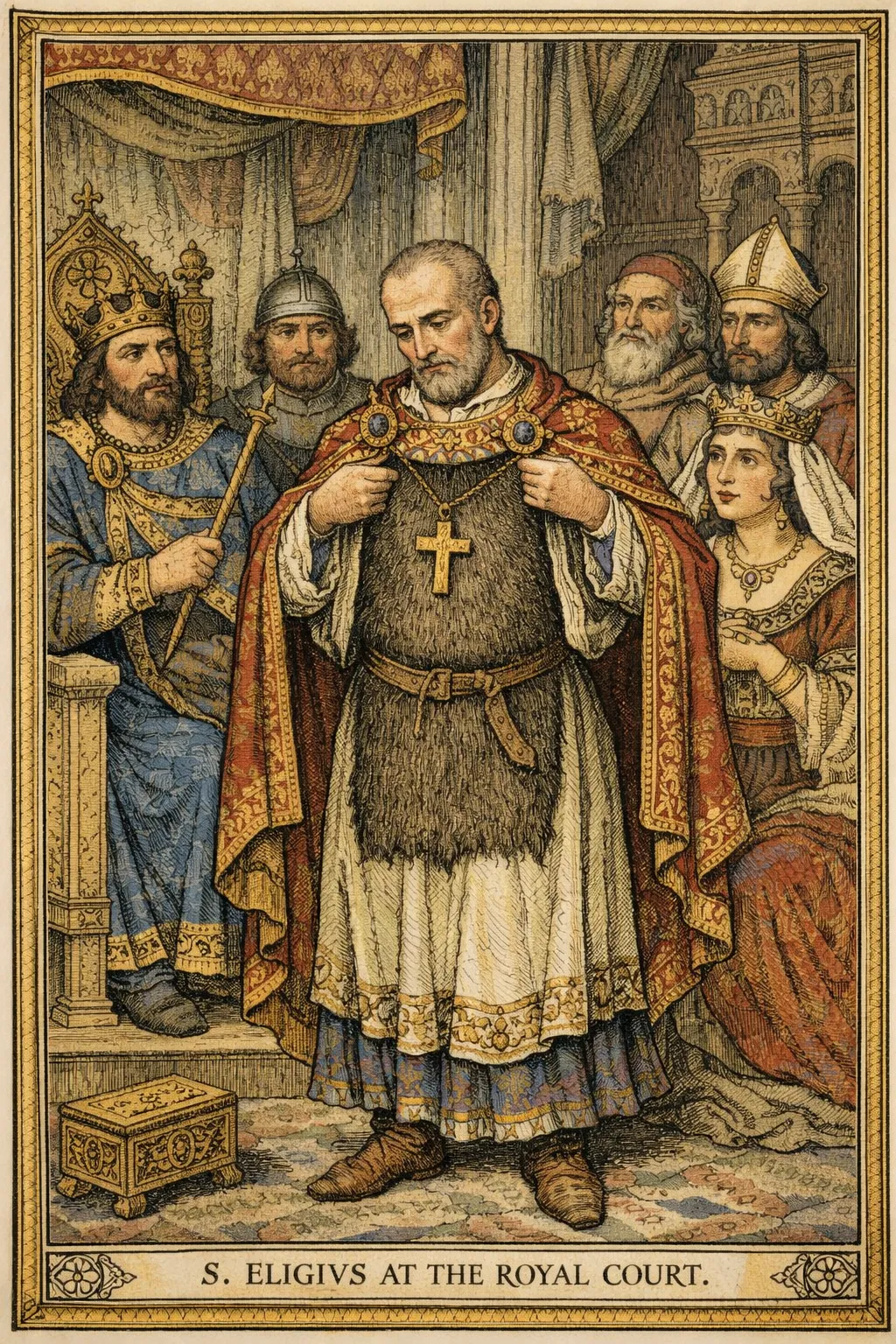
Those who knew Eligius described him as tall, with curly hair and an honest countenance. At court he wore fine silk, jewels, and a belt made of gold. To all appearances, he was a man of extraordinary wealth and taste.
But beneath the gold and gems, he wore a hairshirt against his skin. The luxury was a costume required by his station. The discipline was his own choice. As his faith deepened, Eligius eventually gave away his finery entirely, replacing silk with burlap and his golden belt with rope.
His home was always surrounded by crowds of the poor — that was how visitors found it. He used his royal favor to collect alms, ransom captive slaves arriving at the port of Marseilles, and gave away his personal fortune in large sums.
“ Whenever Eligius heard that slaves were being offered for sale, he did whatever he could to help secure their freedom — Romans, Gauls, Bretons, Saxons, and Moors alike. No nation was excluded from his mercy.
On the Liberation of Captives
Patronage
An extension of his patronage of all who work with metal and tools — those who wire the modern world.
The original trade. Eligius shaped metal at the forge before he shaped the faith of nations.
His first and most celebrated craft. Eligius made reliquaries, thrones, and tombs of breathtaking beauty.
All workers in metal — from machinists to welders to fabricators — fall under his guardianship.
The legendary miracle of the horseshoe made him patron of horses, farriers, and veterinarians.
As master of the royal mint, Eligius struck coins that still survive over 1,300 years later.
The modern inheritors of the craft tradition. Those who keep machines running carry his legacy.
Those who pull raw material from the earth — the first step in the chain of craft Eligius mastered.
The Legend
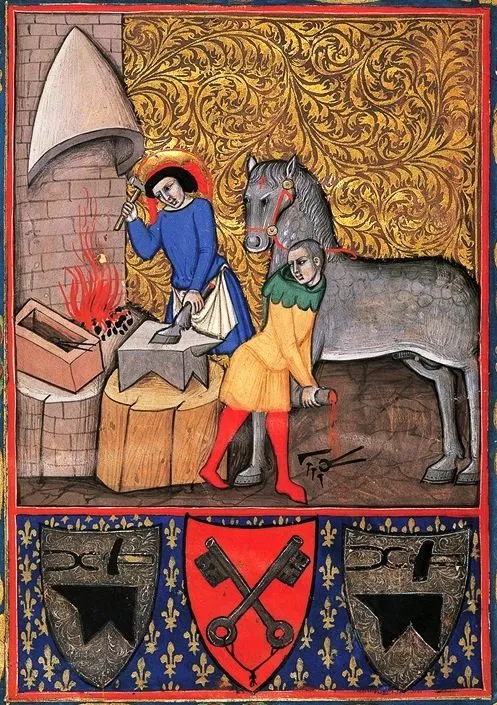
The most famous legend of Saint Eligius involves a horse so wild and restive that it was thought to be possessed by a demon. No farrier could get near enough to shoe it.
According to the story, Eligius calmly removed the horse's foreleg, placed it on his anvil, fitted the horseshoe while the animal stood watching on three legs, and then miraculously reattached the limb.
Some versions hold that Christ himself appeared to help reattach the leg, using the moment to teach Eligius a lesson in humility. The legend — likely medieval folklore rather than historical fact — cemented Eligius as the patron saint of horses, farriers, and all who work at the forge.
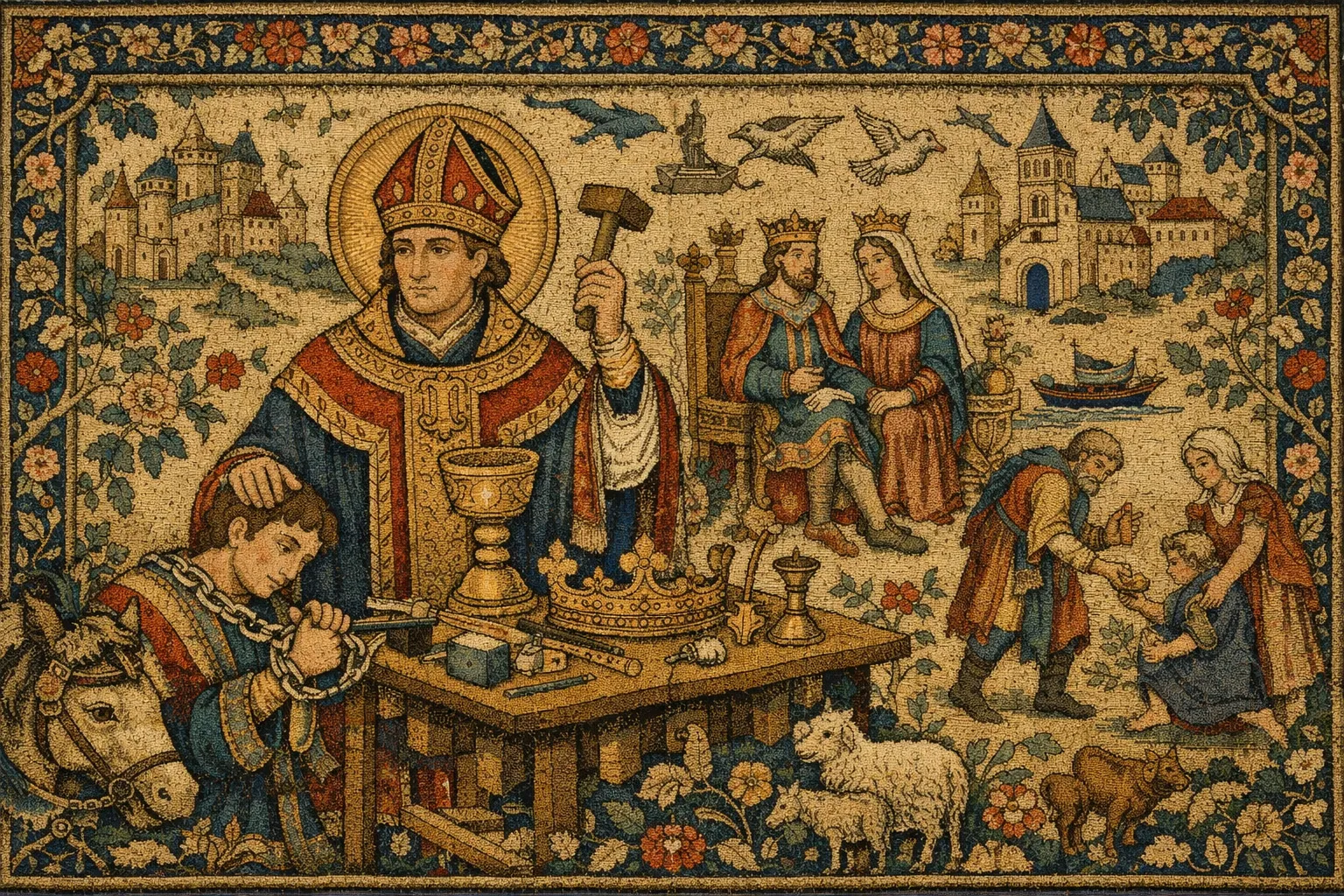
This scene was depicted for centuries in paintings, carvings, tapestries, and church frescoes across Europe — from Botticelli's workshop to the medieval carvings at Wincanton Parish Church to the tapestries at the Hospices de Beaune.
Enduring Legacy
Military
The Royal Electrical and Mechanical Engineers of the British Army adopted Eligius as their patron saint, honoring the connection between military craft, engineering discipline, and the values of integrity he embodied. The Royal Australian Electrical and Mechanical Engineers followed suit in 1990.
Liturgical
A mass honoring Eligius is celebrated around December 9 at Notre Dame de Paris each year for members of the Confraternity of Saint Éloi, carrying forward a tradition that the Parisian goldsmiths' guild revived in 1953 when they donated the altar, crucifix, and a statue of Eligius to the cathedral.
Artistic
Eligius appears in works by Botticelli, Petrus Christus, Taddeo Gaddi, and in countless medieval manuscripts, frescoes, and carved panels. He is almost always depicted in a bishop's vestments alongside a goldsmith's hammer — the two identities he carried through life.
Prayer to Saint Eligius
Saint Eligius, with your hands you wrought beauty,
and with your heart you won friends,
and through both you glorified God.
Befriend us, dear saint,
and pray that we will use our God-given talents
to serve Him.
Amen.
Carry the Patron Saint of Your Trade
Individually vacuum cast and hand finished in Elysium Silver. Designed by request for the people who build the world.
ORDER YOUR TRADE TAG